
Corvedale
Better than "In Babilone"

This was first published in the SJSP Worship aid for the 29th Sunday in Ordinary Time, Year B, on October 20th, 2024.
Today's hymn during the preparation of the gifts, "There's a Wideness in God's Mercy," is one of my favorites for a number of reasons. Firstly, the text is excellent. Fr. Frederick William Faber authored this hymn text along with some of the other favorites including "Faith of Our Fathers," "Hail, Holy Joseph, Hail!" and "Jesus, My Lord, My God, My All (Sweet Sacrament)." The version of the hymn we sing today is slightly altered and modernized from Faber's original language, but only slightly and with no major changes to its content. This is signified by the "alt." at the end of the attribution at the bottom of the hymn. In some instances that small "alt." notation can carry a staggering amount of weight, sometimes leaving the original hymn nearly unrecognizable, but I don't have enough room on the page to lay out my thoughts on that subject.
Now some might recognize this text and may have even sung it before, but set to a different tune. In many hymnals this text will be set with the tune In Babilone, which is in itself a lovely tune, but I find today's tune, Corvedale, to be a perfect fit. If we examine just the first phrase of each of these tunes with this text, we are sure to recognize that Corvedale uses a very simple and effective bit of text painting that sets it apart.
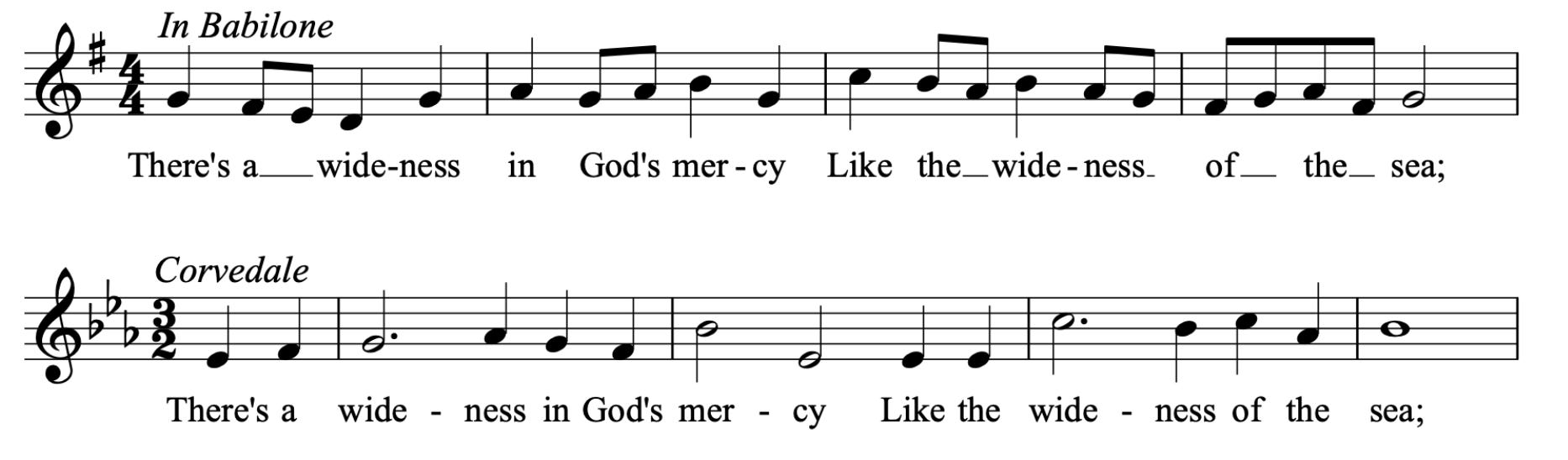
You might notice something metrically interesting on the syllable "wide" in the word "wideness" in Corvedale. This is a simple but beautiful example of text painting, which is the practice of highlighting the literal or figurative meaning of a text through musical means. The word "wide" here is a longer note value both times it occurs in this first line. The rest of the tune is stunningly beautiful to match, and treats the entire text in a gentler and more contemplative way than In Babilone. One simple reason for this difference is that Corvedale was written for this text specifically, whereas In Babilone was an existing tune with a matching meter, so hymnal editors thought it a good fit for the text by Fr. Faber.
Maurice Bevan composed Corvedale and named it after the river Corve in Shropshire where he was raised. Bevan was a chorister at St. Paul's Cathedral in London and was not an acclaimed composer in popular culture. Rather, he was a church musician composing service music for the liturgy. Maybe that explains why it is so excellent!